For those of you working with Gregorian Chant, I've posted some materials at:
http://homepage.mac.com/mhettinger/StJoeGregorian/index.html
umm...it's not the same format as I see in other places, but I'm swimming in the ocean of the people around me. There's a reason for everything, and my goals for rendering chant are always authenticity and meaning.
I'm very interested in your reactions.
pax,
maggie
Friday, November 17, 2006


Friday, September 29, 2006
The Vow of Nonviolence
Recognizing the violence in my own heart, yet trusting the goodness and mercy of God and the universe, I vow or solemnly affirm that I will strive to live a life of nonviolence:
*striving for peace within myself and seeking to be a peacemaker in my daily life;
* showing love, compassion and forgiveness to everyone I meet;
* accepting suffering in the struggle for peace and justice rather than inflicting it;
* persevering in nonviolence of tongue and heart;
* living conscientiously and simply so that I do not deprive others of the means to live;
* striving to treat the natural world not as a resource but as a beloved member of my family, and
* working nonviolently to abolish war and the causes of war from my own heart and from the face of the earth.
Lord, I trust in your sustaining love and believe that just as you gave me the grace and desire to offer this, so you will also bestow abundant grace to fulfill it.
*striving for peace within myself and seeking to be a peacemaker in my daily life;
* showing love, compassion and forgiveness to everyone I meet;
* accepting suffering in the struggle for peace and justice rather than inflicting it;
* persevering in nonviolence of tongue and heart;
* living conscientiously and simply so that I do not deprive others of the means to live;
* striving to treat the natural world not as a resource but as a beloved member of my family, and
* working nonviolently to abolish war and the causes of war from my own heart and from the face of the earth.
Lord, I trust in your sustaining love and believe that just as you gave me the grace and desire to offer this, so you will also bestow abundant grace to fulfill it.
Thursday, July 13, 2006
PSYCHOLOGY: Close Encounters
---------------------------------------------------------------------------
PSYCHOLOGY: Close Encounters
---------------------------------------------------------------------------Gilbert
J. Chin
The effect of contact between groups on prejudice has been a topic of
research at least as far back as the middle of the 20th century. Since
then, there have been a very large number of studies and many reviews of
this literature. Pettigrew and Tropp have conducted a meta-analysis of what
has become known as intergroup contact theory. They (and their dedicated
research assistants) have combed through published papers and unpublished
dissertations, using a methodological (rather than topical) basis for
inclusion; the final data set covers 515 studies, containing over 700
independent samples representing a quarter million individuals spread over
38 countries. The summary finding is that intergroup contact reduces
prejudice.
Their statistical analyses reveal that this cannot be ascribed to
self-selection by the participants, or to a publication bias toward
positive results, or to the rigor of the research (methodologically
stronger studies yielded larger effect sizes). Roughly half of the studies
focused on nonracial and nonethnic groups (as described by sexual
orientation or physical or mental disability, for example), and the effect
sizes seen within this subset were the same as that for the racial/ethnic
targets that stimulated the historical development of intergroup contact
theory. Furthermore, it appears that the effects on individual attitudes
can generalize to other members of the outgroup and even to other
outgroups.
How is this mediated? They find that Allport's four features (common goals,
intergroup cooperation, equal status, and official sanction) contribute
significantly to the reduction of prejudice but are not essential, and that
the last of the four conditions may be the most important one. Greater
contact may reduce feelings of uncertainty or discomfort that might
otherwise coalesce into anxiety or perceived threat, which might in turn
harden into prejudice. Yet these ameliorative shifts may not survive in the
absence of normative or authoritarian support, and studies of why contact
fails to curb prejudice are needed. -- GJC
J. Pers. Soc. Psychol. 90, 751 (2006).
PSYCHOLOGY: Close Encounters
---------------------------------------------------------------------------Gilbert
J. Chin
The effect of contact between groups on prejudice has been a topic of
research at least as far back as the middle of the 20th century. Since
then, there have been a very large number of studies and many reviews of
this literature. Pettigrew and Tropp have conducted a meta-analysis of what
has become known as intergroup contact theory. They (and their dedicated
research assistants) have combed through published papers and unpublished
dissertations, using a methodological (rather than topical) basis for
inclusion; the final data set covers 515 studies, containing over 700
independent samples representing a quarter million individuals spread over
38 countries. The summary finding is that intergroup contact reduces
prejudice.
Their statistical analyses reveal that this cannot be ascribed to
self-selection by the participants, or to a publication bias toward
positive results, or to the rigor of the research (methodologically
stronger studies yielded larger effect sizes). Roughly half of the studies
focused on nonracial and nonethnic groups (as described by sexual
orientation or physical or mental disability, for example), and the effect
sizes seen within this subset were the same as that for the racial/ethnic
targets that stimulated the historical development of intergroup contact
theory. Furthermore, it appears that the effects on individual attitudes
can generalize to other members of the outgroup and even to other
outgroups.
How is this mediated? They find that Allport's four features (common goals,
intergroup cooperation, equal status, and official sanction) contribute
significantly to the reduction of prejudice but are not essential, and that
the last of the four conditions may be the most important one. Greater
contact may reduce feelings of uncertainty or discomfort that might
otherwise coalesce into anxiety or perceived threat, which might in turn
harden into prejudice. Yet these ameliorative shifts may not survive in the
absence of normative or authoritarian support, and studies of why contact
fails to curb prejudice are needed. -- GJC
J. Pers. Soc. Psychol. 90, 751 (2006).
Saturday, June 24, 2006
Wednesday, June 21, 2006
Monday, May 22, 2006
Saturday, January 21, 2006
Thursday, January 19, 2006
Five essential elements of leadership "as leadership":
Leadership
Guides the way
Speaks truth
Creates, nurtures, or protects group identity,
perhaps by naming and eliminating the enemy
Acts decisively
"and it's got to make you glad to be alive."
Guides the way
Speaks truth
Creates, nurtures, or protects group identity,
perhaps by naming and eliminating the enemy
Acts decisively
"and it's got to make you glad to be alive."
Thursday, December 08, 2005
weather or not
So, is it the weather? I've just had two phone calls in a row that really stretched my tolerance. (My tolerance is pretty low, anyway.)
I'm stuck in a horrible situation right now, so I don't have much to give to anybody except a resolve not to pass on any bad karma.
One conversation about drawing the line about church and liturgy. I draw lines, too, but when I find myself at that point, it feels like total failure.
Another from someone whose life is so incredibly messed up he'll never pull it together, and I'm stuck listening to him telling me why someone else is impossible to live with.
I don't want to argue about anything. Just live and let live.
It would be nice to get some constructive work done, too.
I'm stuck in a horrible situation right now, so I don't have much to give to anybody except a resolve not to pass on any bad karma.
One conversation about drawing the line about church and liturgy. I draw lines, too, but when I find myself at that point, it feels like total failure.
Another from someone whose life is so incredibly messed up he'll never pull it together, and I'm stuck listening to him telling me why someone else is impossible to live with.
I don't want to argue about anything. Just live and let live.
It would be nice to get some constructive work done, too.
Wednesday, December 07, 2005
Special effects take the light from Harry Potter
If you've been to see the Goblet of Fire, you know that it has some of the most believable, seamless special effects of any fantasy movie. The dragon is the best I've seen. The underwater scene, in which Harry turns into a fish-person, is eerie and convincing. Merpeople and grindylows are believable.
Unfortunately, these beautiful, stunning, entertaining effects diminish the main line of the story of Goblet of Fire, take away the tension. Rowling's Goblet of Fire is a two-layered thriller. The background line is the extreme threat of Voldemort in Harry's life. The foreground school story features everyday challenges that are not evil, but extremely difficult, and this is the sense that is missing from the movie.
In the books, the TriWizard Tournament is a somewhat-over-the-top school event. It reminds me of the Wide Games we used to hold at Girl Scout camp, where everyone went all-out for some kind of theme adventure in which we immersed ourselves for a few hours or a few days. If it's a little overenthusiastic, well, so are our state football championships. People get hurt in them, too.
In the book, the dragon challenge is plenty real to Harry and the contestants, but the dragons are tethered, and a dozen wizards are standing by to stun the beasts if they get out of hand. It's a challenge of nerve, preparation and courage. We are priveleged to Harry's feelings of inadequacy and dread, and his huge relief when he finds himself able to use his Quiddich skill to meet the challenge well.
Harry's preparation for the second task is mostly avoidance. Rowling makes exquisite use of his awareness of time passing without this huge problem being solved. He does eventually start to prepare, but not soon enough were it not for luck (Dobby's help). When the task happens, the merpeople are there to see to the contestants' safety. Harry's near-drowning in the movie, while entertaining, would not have happened in the book-story. And for this reason, the book gives us the emotional tension of Harry's accomplishing the task, followed by acute embarrassment at coming in last because of taking it too seriously. He conquered the physical challenge, but missed the boat on the social challenge, he thinks, and THEN is exonerated by the judge's award of second place for "moral fibre." To me, this is more emotionally satisfying than a pretty rescue and escape scene.
The third task is very different for Harry. The second task has taught him how to prepare, and he, Hermione, and Ron spend a very large amount of time cramming and preparing. They research magical techniques, practice and perfect them. For the third task, Harry is nervous, but not afraid. He is ready. It's a real challenge, and the true challenge, as we see, is not one of skill, but of his sense of fairness.
THEN, the evil of Voldemort breaks in. And it is really evil. But Harry has grown, and his escape is not just luck or protection. His own growth is a very real part of what saves him.
So you see, the over-the-top movie effects cheat Harry of the very real accomplishments and growth. They also cheat the story line, for when the true beyond-his-skill challenge of Voldemort comes, we've long since suspended our disbelief, so there's no real shock or surprise. It's just another fantasy story.
Reading between the lines, director Mike Newell has said he was frustrated that the special effects had such a life of their own. I agree. Stunning as they are, they took away from the chance to tell the human story--a story of a person faced with difficulties who learns to overcome them, later finding himself able to prevail against unexpected difficulty.
I read somewhere that the special-effects people are salivating at their chance to portray Grawp in the next story. Well, I'd like to see Grawp well-done, but even more, I'd like to see the character interplay of the human side of the story. Order of the Phoenix is very much about people, their misconceptions in time of danger, their blindness and meanness. Ultimately it becomes the story of their ability (esp. Dumbledore's Army) to take charge of their own lives cooperatively. I'd hate to let this human story be swamped by special effects.
Unfortunately, these beautiful, stunning, entertaining effects diminish the main line of the story of Goblet of Fire, take away the tension. Rowling's Goblet of Fire is a two-layered thriller. The background line is the extreme threat of Voldemort in Harry's life. The foreground school story features everyday challenges that are not evil, but extremely difficult, and this is the sense that is missing from the movie.
In the books, the TriWizard Tournament is a somewhat-over-the-top school event. It reminds me of the Wide Games we used to hold at Girl Scout camp, where everyone went all-out for some kind of theme adventure in which we immersed ourselves for a few hours or a few days. If it's a little overenthusiastic, well, so are our state football championships. People get hurt in them, too.
In the book, the dragon challenge is plenty real to Harry and the contestants, but the dragons are tethered, and a dozen wizards are standing by to stun the beasts if they get out of hand. It's a challenge of nerve, preparation and courage. We are priveleged to Harry's feelings of inadequacy and dread, and his huge relief when he finds himself able to use his Quiddich skill to meet the challenge well.
Harry's preparation for the second task is mostly avoidance. Rowling makes exquisite use of his awareness of time passing without this huge problem being solved. He does eventually start to prepare, but not soon enough were it not for luck (Dobby's help). When the task happens, the merpeople are there to see to the contestants' safety. Harry's near-drowning in the movie, while entertaining, would not have happened in the book-story. And for this reason, the book gives us the emotional tension of Harry's accomplishing the task, followed by acute embarrassment at coming in last because of taking it too seriously. He conquered the physical challenge, but missed the boat on the social challenge, he thinks, and THEN is exonerated by the judge's award of second place for "moral fibre." To me, this is more emotionally satisfying than a pretty rescue and escape scene.
The third task is very different for Harry. The second task has taught him how to prepare, and he, Hermione, and Ron spend a very large amount of time cramming and preparing. They research magical techniques, practice and perfect them. For the third task, Harry is nervous, but not afraid. He is ready. It's a real challenge, and the true challenge, as we see, is not one of skill, but of his sense of fairness.
THEN, the evil of Voldemort breaks in. And it is really evil. But Harry has grown, and his escape is not just luck or protection. His own growth is a very real part of what saves him.
So you see, the over-the-top movie effects cheat Harry of the very real accomplishments and growth. They also cheat the story line, for when the true beyond-his-skill challenge of Voldemort comes, we've long since suspended our disbelief, so there's no real shock or surprise. It's just another fantasy story.
Reading between the lines, director Mike Newell has said he was frustrated that the special effects had such a life of their own. I agree. Stunning as they are, they took away from the chance to tell the human story--a story of a person faced with difficulties who learns to overcome them, later finding himself able to prevail against unexpected difficulty.
I read somewhere that the special-effects people are salivating at their chance to portray Grawp in the next story. Well, I'd like to see Grawp well-done, but even more, I'd like to see the character interplay of the human side of the story. Order of the Phoenix is very much about people, their misconceptions in time of danger, their blindness and meanness. Ultimately it becomes the story of their ability (esp. Dumbledore's Army) to take charge of their own lives cooperatively. I'd hate to let this human story be swamped by special effects.
Monday, November 21, 2005
Kelpie Wilson | Thanksgiving Day 2005
t r u t h o u t - Kelpie Wilson | Thanksgiving Day 2005: "We are like the addict who would have died of an overdose if he hadn't run out of smack first, so let's be thankful that our supply is being cut off."
Tuesday, November 08, 2005
Monday, October 17, 2005
life, the universe, and everything in two sentences
"The difference between one and more-than-one
is all the difference in the world.
Indeed, that difference is the world."
--Ursula LeGuin, The New Atlantis, The Compass Rose, p. 17
is all the difference in the world.
Indeed, that difference is the world."
--Ursula LeGuin, The New Atlantis, The Compass Rose, p. 17
Tuesday, August 23, 2005
Cindy's questions and mine
WHY are they dying?
WHEN will it end???
It's about Oil.
It's about Domination.
It's about Money
& Freedom to exploit.
It's NOT about Democracy.
Whose children will be sacrificed today?
WHEN will it end???
It's about Oil.
It's about Domination.
It's about Money
& Freedom to exploit.
It's NOT about Democracy.
Whose children will be sacrificed today?
Thursday, August 18, 2005
Cindy Sheehan
We held vigil last night with Cindy Sheehan.
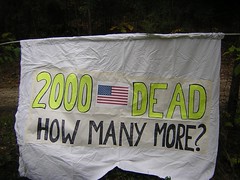
We, too, believe that our government is NOT answering the following questions:
Why did we go to war?
How many have died because of this?
When will our military come home?
We, too, believe that our government is NOT answering the following questions:
Why did we go to war?
How many have died because of this?
When will our military come home?
Subscribe to:
Posts (Atom)