Saturday, June 12, 2004

Cibavit eos.mp3


Cibavit eos page 1 Posted by Hello


Cibavit Eos p2 Posted by Hello

Latin text:
Antiphon:
Cibavit eos ex adipe frumenti, alleluia:
et de petra, melle saturavit eos, alleluia, alleluia, alleluia.

Verses:
Simite psalmum, et date tympanum:
psalterium iucundum cum cithara.


Ego enim sum Dominus Deus tuus, qui eduxi te de terra AEgypti:
dilata os tuum, et implebo illud.


English text:
He should have fed them also with the finest of the wheat:
and with honey out of the rock should I have satisfied thee.

Take a psalm, and bring hither the timbrel,
the pleasant harp with the psaltery.

I am the LORD thy God, which brought thee out of the land of Egypt:
open thy mouth wide, and I will fill it.


Chant Source:
Psalm 81(80)
Graduale Triplex pp. 377-378

Introit for the Solemnity of the Most Holy Body and Blood of Christ

Thursday, June 10, 2004

Lake Tahoe, IUEC Conference (Elevator Constructors)

I got back too late yesterday to talk to anyone about that crest trail. Since I know there's snow up there, and my shoes are not good for that, I guess I won't. Frank has an early-morning breakfast meeting, so I'd have to get other transportation. My feet are saying don't. (But they'd change their mind once I got them there.)

Two more articles in Worldwatch have my attention. One is the article: Scrapping Mining Dependence, by Payal Sampat ( State of the World 2003 ). It's opening up whole new areas in my mind about our social habits that keep us destroying habitat and people's lives to produce metals and materials, some of which are much more available already in our garbage. Some of which we don't really need for anything (diamonds, gold, jewelry stuff). (Three tons of cyanide-laced waste is produced for each gold wedding ring.) Mining is highly subsidised by our government, therefore, we keep right on doing it. I think I'll pay more attention to our recycling, at least. Lobby for political change at best.

The other article, which I've been putting off, is "Engaging Religion in the Quest for a Sustainable World," by Gary Gardner ( State of the World 2003 ). I hope to write more about this later, but it clarified to me why Fr. Pat Creed had such a resonance with us. His interpretation of Gospel, of liturgy, of Church, is thoroughly entwined with the ethic of conservation and ecology. Fr. Pat Creed was one of the movers and shakers in the challenge stated in this article:

Our civilization's challenge is to reintegrate our societal heart and head, to reestablish spirituality as a partner in dialogue with science.


Fr. Pat's homilies thoroughly embody a vision of church in which the "old" church is in harmony with the "new" church, and the kingdom of God is very much in harmony with an educated, scientific view of ecology. I miss that man.

(This also clarifies for me why I couldn't stay longer at Holy Trinity, where Yuppie, money-driven, elitest "empowerment" pretty well submerges anything else. )

Any environmentalist wanting to follow Gardner's advice and link the environmental movement with the Christian concept of avoiding preoccupation with wealth, materialism, and excessive consumption, couldn't do much better than to mine Fr. Pat's lifework of homilies. I plan to continue posting them at A Catholic's Companion, and hope to keep them available in print at Watchmaker Press .

Wednesday, June 09, 2004

Lake Tahoe, IUEC Conference (Elevator Constructors)


Back at last. Posted by Hello

I was disappointed by out little Motorola T6320 Talkabout walkie-talkie gizmos. Frank had contacted me at noon, and we'd talked then, but we couldn't get the he compass functions to help us out. All day, I'd tried to contact Frank, and it never worked. Even at this point, close to and in direct line-of sight, I couldn't call him. Of course he was worried. I found him in a meeting for new Business Agents. I stayed for part of the presentation and picked up some good tips for using a spreadsheet.

Lake Tahoe, IUEC Conference (Elevator Constructors)


Coming down from High Camp Posted by Hello

After exploring the Olympic ghost-complex a little, I asked a runner about the road he had just run up (all the way from the bottom, I presume). This 'road' somehow took ME to a funky cul-de-sac, but I could see real road below me, and what LOOKED like trails leading to it, so I decided to take that way. Hmmm. Well, I was concerned about the erosion I caused, because a lot of what I did for the next hour involved sliding fairly vertically down thru scrub and deep, loose dirt. Eventually, though, I came out on a service road and walked it back to that Olympic village place where I'd started.

Lake Tahoe, IUEC Conference (Elevator Constructors)


Several hours above and beyond Shirley Lake, looking down from 1984 Olympic High Camp. Posted by Hello

Christian and his friends offered to show me the road. I said I'd like to do that, but my walking speed wasn't as fast as theirs. They offered to wait, if necessary. They treked on. I huffed and puffed. They headed straight up the middle of the snow fields. My tennis shoes would NOT do snow without slipping, so I zig-zagged around when possible, dug in with an abandoned ski pole when I had to. Eventually, I pointed up to a black machine thing and said, "If I'm at that thing, will I see the road?" They said yes, so I thanked them and they went on. I went on more slowly, and more zig-zagged, but at some point I was about 20 feet below the "top," with nothing but a wall of snow between myself and it. I found a small piece of wood, and with that in my right hand and the ski pole in my left, I dug into the snow and pulled myself up it. What a great adventure! (No real danger. I could alway just have gone back the other way.)

Lake Tahoe, IUEC Conference (Elevator Constructors)


Shirley Lake at last Posted by Hello
I think it was about 3:00 when I got to Shirley Lake. Looking for the cable car, I followed a maintained trail left around the lake and generally up. At some point, though, it petered out into an area of snow fields and wooded meadows. (Sorry about the oxymoron, but that's what it was). I wandered thru this for an hour or so, then took darkening clouds into consideration and decided to go back to the marked trail to go back. (It was a little bit of a scramble to get to Shirley Lake again.) I got there and went beyond, to the big rock fields, where I met some other hikers (first I'd seen) and asked them about the road(s) at the top.

Lake Tahoe, IUEC Conference (Elevator Constructors)


Still up. (some downs, only when lost.) Follow the blue blazes. Posted by Hello

This time, my goal was to stay on the trail. Most of the time it was easy, for it's marked with blue paint. There were two separate times where I spent close to an hour searching for the trail. Once, I finally found it, then traveled for a half-hour to a point where I was shocked to find a footprint, when I hadn't heard any other hikers all day. Shortly after that, I realized I'd been there before. I'd lost at least 1/2 hour of steep altitude. I went back and puzzled again at the place I lost it. After a while, I took pictures to document the 'end' of the trail. After I took the pictures, I followed one of the possibilities (yet again), and this time, it took me on up the mountain. I thought about going back and figuring out why I hadn't found it before, but decided not to. It was like a magic gate in a fantasy story. If I'd gone back, the way might have closed up again and I'd have been going around in circles to nowhere all day.

Lake Tahoe, IUEC Conference (Elevator Constructors)


A bit of the view back toward the hotel (in the green patch) Posted by Hello

Lake Tahoe, IUEC Conference (Elevator Constructors)


On up the trail Posted by Hello

Lake Tahoe, IUEC Conference (Elevator Constructors)


Maggie heading up Shirley Lake Trail. Posted by Hello

This time I made sure I was on the LEFT-HAND SIDE of the creek when I found the trailhead. It was there. It even had a sign saying that fo $10 you could take a cable car back down. I thought that made a nice option.

Lake Tahoe, IUEC Conference (Elevator Constructors)


Surprise! Snow in June! Posted by Hello

Frank was up early for a breakfast meeting. I'd been up earlier, since my body was on eastern time, why fight it? I'd been reading. The snow was a surprise. He went for his meeting, I went walking. I layered my clothes with some fancy dress sweaters underneath. Took a pair of extra socks in case I needed to use them for gloves. Took the walkie-talkie to check in. I had a new hat and an old poncho. It turned out to be a good hat. All morning walking thru wet snow, and my glasses never got wet.

Tuesday, June 08, 2004

Lake Tahoe, IUEC Conference (Elevator Constructors)

I spent the morning scoping out possible hiking trails. I found one that walked for 17 miles over mountain crest trail. It ended at Tahoe Meadows. The distance seems far, but it doesn't look like much elevation change, just an all-day stroll. Frank would have to take me there early and pick me up, so I located the trailheads. I hope to do this on Thursday. I took the Tahoe Meadows trail. Stunningly beautiful.

I spent the afternoon reading from Laura's
2003 State of the World
from the WorldWatch Institute. It's rich reading--up-to-date analysis of our society's relationships with ecology.

After reading "Watching Birds Disappear", by Howard Youth, I learned that birds are a 'marker' of good ecology. I penned this:

Convert tobacco subsidies to wild-bird habitat farming. Choose bird species that are markers for good Kentucky ecology. Paid according to success--# of birds.

People who already receive tobacco subsidies would be randomly chosen over a 5-year span. They may decline IF another tobacco-subsidy entity volunteers to take their place. If not, they simply lose their subsidies. Provide incentives for 1st years, decreasing.

Include suppliers and secondary benifitters of tobacco-growing and marketing. Consider a counter-incentive, i.e., 95% of current tobacco producers will be included over the 5 years. (YOU COULD LOSE OUT). Decisions made by random selection & volunteering.

I also watched a public-TV show with a motivational speaker. Crazy thing to do at a resort? No. We can't get public TV at our house. sigh.

Monday, June 07, 2004

Lake Tahoe, IUEC Conference (Elevator Constructors)


Up the trail on the wrong side of the creek. Posted by Hello


The resort shuttle took me over to the area which we ladies had walked to in the morning. He let me off at a trail (following to the right of the creek that formed the canyon). This trail (these trails) meandered all over the place. Lots of people around, at first. It took a lot of backtracking and bushwacking, but by 3:00 ( my turnaround time) I'd almost made it to the crest to the other side.

I never WAS on the Shirley Lake Trail. It was a good day, though. I think I LIKE hiking by myself. Never done it before.

Lake Tahoe, IUEC Conference (Elevator Constructors)


Shirley Lake Trail map Posted by Hello

In the morning I walked with some of the other ladies in a long loop around the golf course to another Olympic area. We split up on the way back and I walked up the mountains behind the resort. Not having talked to anyone about the state of the wildlife, I didn't go too far, and came back, talked to the good lady at the desk, and got a map of the Shirley Lake Trail.

Sunday, June 06, 2004

Lake Tahoe, IUEC Conference (Elevator Constructors)


Silver mine lift, Nevada Mint museum Posted by Hello

Lake Tahoe, IUEC Conference (Elevator Constructors)


Frank & meadow stream Posted by Hello

We spent the day driving counter-clockwise around the lake. A zillion bikers were traveling the other way. This photo is part of a meadowland nature trail at one of the state parks.

Lake Tahoe, IUEC Conference (Elevator Constructors)


Sunday breakfast on Lake Tahoe Posted by Hello

Yes, the water really is that blue. Also the sky. Even bluer.

Wednesday, June 02, 2004

Propers for the Church Year: 1. Season of Advent

Propers for the Church Year: 1. Season of Advent

Here is an ambitious work-in-progress. Propers for the Church Year, with square notation and audio. What a resource!

Gregorian Chant: Pater cum essem cum eis.mp3


Pater cum essem Posted by Hello

John 17:12,13,15

Latin text:
Pater, cum essem cum eis,
ego servabam eos, quos dedisti mihi, alleluia:
nunc autem ad te venio:
non rogo ut tollas eos de mundo,
sed ut serves eos a malo, alleluia, alleluia.


English text:
When I was with them I protected them in your name that you gave me...
But now I am coming to you.
I speak this in the world so that they may share my joy completely.
I do not ask that you take them out of the world but that you keep them from the evil one.

Chant Source:Graduale Triplex

Gregorian Chant: Ascendit Deus.mp3


Ascendit Deus Posted by Hello

Psalm 47(46):6
Offertory, Ascension of the Lord
A piece of chant that's as evocative as a film--big-sky effects, trumpet calls, real jubilation.

Latin text:
Ascendit Deus in iubilatione, Dominus in voce tubae, alleluia, alleluia, alleluia.
English text:
God mounts the throne amid shouts of joy; the LORD, amid trumpet blasts.

[Modern-notation score available HERE]

Chant Source:Graduale Triplex

The recording is merely acceptable. It shows how the chant can be sung. I'd like to hear it sung powerfully and exuberantly by an accomplished vocalist.

Ego Clamavi Posted by Hello

Questionnaire on Eucharist


Zenit News Agency - The World Seen From Rome
: "VATICAN CITY, JUNE 1, 2004 (Zenit.org).- A questionnaire sent out by the Holy See to prepare for next year's Synod of Bishops will serve to evaluate how the baptized celebrate and live the Blessed Sacrament.

The questionnaire begins with these three questions: 'What importance does the celebration of the Eucharist have in the life of your communities and of the faithful? What is the participation in the Holy Mass on Sundays, on weekdays, in the great feasts of the liturgical year? Are there any approximate statistics in this regard?'

There are more questions. I'd like to see them answered by some of us folks who are active in the Church and it's liturgy, but don't usually participate in such things. If you want to reply to this, I'll collate and make sure our answers get to the Archdiocese. I expect they'll be glad to have them. I'd really like to get our slant on this.


"

. taste of salt .

. taste of salt .: "Paradox


A Columbine High School student wrote:

The paradox of our time in history is that
we have taller buildings, but shorter tempers;
wider freeways, but narrower viewpoints;
we spend more, but have less;
we buy more, but enjoy it less.

We have bigger houses and smaller families;
more conveniences, but less time;
we have more degrees, but less sense;
more knowledge, but less judgment;
more experts, but less solutions;
more medicine, but less wellness.

We have multiplied our possessions, but reduced our values.
We talk too much, love too seldom, and hate too often.
We've learned how to make a living, but not a life;
we've added years to life, not life to years.
We've been all the way to the moon and back, but have trouble crossing the street to meet the new neighbor.

We've conquered outer space, but not inner space;
we've cleaned up the air, but polluted the soul;
we've split the atom, but not our prejudice.
We have higher incomes, but lower morals;
we've become long on quantity,but short on quality.

These are the times of tall men, and short character;
steep profits, and shallow relationships.
These are the times of world peace, but domestic warfare;
more leisure, but less fun; more kinds of food, but less nutrition.
These are days of two incomes, but more divorce;
of fancier houses, but broken homes.

x tasted salt at 4/29/2004 12:47:55 PM x"

Tuesday, June 01, 2004

TheStar.com - In the service of civilization

TheStar.com - In the service of civilization: " 'How much physics do we need to know?' Toporoski's point is that knowing some Latin is more useful than knowing a bit of physics. English, Latin and Greek literature are 'the greatest in the world. And to be able to read these in the original.... If you believe there's more to life than making money and pushing people around, to be able to reflect on the human situation or to handle the English language with some sensitivity ...

From Marine to nun


From Marine to nun


More good reading. Maybe there's hope for me. But I have to do it here, not in the monastery.

Haaretz - Israel News - A Sunday morning in church.com

Haaretz - Israel News - A Sunday morning in church.com: "The Church was the first institution to adopt the subversive technology of printing as a tool for spreading the faith more than 500 years ago. There is no reason to assume it cannot find a successful way to deploy the Internet as a tool in its sacred service."

This article from an Israeli source gives a little perspective on the "Church of Fools." I think I'll check them out.

Monday, May 31, 2004

SibeliusMusic.com website Expressive Chant Scores

Maggie Hettinger

I just set up a web page on SibeliusMusic.com as a place to post the "standard-notation" versions of chants as I do them.

I'm not sure if that's the way to go, at all, but people seem to want them, and it may help crack the nut. If you visit the site, there's a place to register to be notified every time a new score is published.

Common Sense and Computer Analysis (washingtonpost.com)

Common Sense and Computer Analysis (washingtonpost.com)

I'm always amazed at how people misunderstand computers and computing. We have the most amazing tools at our fingertips, but we don't use them, and maybe don't WANT to use them.

This article begins:
"Irrational paranoia about computer technology threatens to shut down an entire front in the war on terror.

"A prestigious advisory panel has just recommended that the Defense Department get permission from a federal court any time it wants to use computer analysis on its own intelligence files. It would be acceptable, according to the panel, for a human agent to pore over millions of intelligence records looking for al Qaeda suspects who share phone numbers, say, and have traveled to terror haunts in South America. But program a computer to make that same search, declares the advisory committee, and judicial approval is needed, because computer analysis of intelligence databanks allegedly violates 'privacy.'"

The Technology Connection should be required in every school.

Sunday, May 30, 2004

Chant at St. Joe

We sang Spiritus Domini at Preparation of the Gifts of this morning's mass at St. Joseph Proto-Cathedral. We rehearsed carefully beforehand, working for a blended sound, reminding ourselves of the tricky parts. This is the first week working with a new sound system, and, as the choir is miked, I determined that we could sing softly and work for blend rather than volume.

I think we sang well. For some reason my minidisc recorder malfunctioned, and I didn't get the recording at all. (I probably can't blame it on the recorder. Usually it's the "recorder" who has a problem--the traditional "short between the earphones.") Rats.

I hope they ask to do more chant.

Gregorian Chant "Eucharistie': CD-review

Gregorian Chant: CD-review:

From a review by Willy Schuyesman for the CD "Eucharistie."

"The 20-member choir conducted by the charismatic father Gereon van Boesschoten has beautiful voices, and benefits from the fact that its members have had more than 20 years to blend in their voices into the choir sound, resulting in a nice and pleasing homogenous sound.

"And because of these substantial advantages, I find it all the more disappointing that the choir still performs Gregorian chant according to the performance rules of the beginning of the century. Beautiful as that may sound, it is still a pity that they seem not to have heard of Cardine or his capital research into the repertoire: all notes have the same length, an almost mathematical average, with no expressive extras whatsoever on important notes or words. One would have hoped that by now, most singers are aware of the rhythmic subtleties hidden in the neumes and their importance for a right interpretation of the text.

"But as we said, the feast of the Holy Sacrament was fairly recent addition, which means that many of its chants were composed at a time when the rhythmic characteristics had sunk into oblivion under polyphonic pressure. This means that in a number of cases, the choir could get away with a fairly ‘egalitarian’ musical approach. Yet the proper of Mass originated much earlier on, most of the chants featuring in manuscripts dating back to the late 900s, and therefore deserves much more rhythmical attention. In the introit Cibavit eos, for instance, there are a number of occasions (say the two last Alleluias) where we can hear the first note of the quilisma being stressed, whereas semiologists have long discovered that it is the last note of quilismas and scandici that need stressing. Or the gradual Oculi omnium, where every hint of musical build-up in Oculi is simply flattened out by making all the notes the same length. The same happens in the responsory Unus panis, where the solo part clearly demonstrates that this approach simply destroys the structure of the chant."

----------------

So, I'm not the only person looking for more in the chant.

The track Qui manducat is available for download on the link above. It's interesting to me that some of the words are juxtaposed from what I'm accustomed. It's the first time I've run into that.

Saturday, May 29, 2004

Holy Name Band at Corydon

Last night's concert at the bandstand in Corydon, IN was begun by the veterans presenting a flag ceremony, reading the names of all of the county's war dead, and a (21?-)gun salute. It was very effective and there was a large audience in attendance. I hope they do it this way every year.

We played well, too. Must be the end of the season. ;)

Friday, May 28, 2004

To Parishes which must close their schools

(St. Brigid in Vine Grove is closing their elementary school. I've known about this for months. After reading an article in the Record, I decided to send a letter to some of the key people in the parish. Since I'd like to send the same letter to about a zillion parishes, I'll post it here, and maybe someone will use it.)

Dear parish member,

Your parish has been on my mind ever since I heard that the school was going to be closed. As a member of St. Benedict Parish and former teacher at the school, I strongly sympathize with the anxiety and grief that you must be going through. When our school had to close, it was an experience like none other.

I want to share something with you. We had identified our values something like this:

o Membership in an ongoing faith community.
o Pervasive involvement in the church’s liturgy.
o Quality education.
o Religious instruction.
o Parish presence in the traditions and functions of the greater community.

Any parish that can move outside the box just a little and think modularly has all the resources to continue these things. Picture this:

Parents bring children to your parish school each morning. Four days of the week they begin with liturgy (mass or morning prayer), followed by 20 min. activity. The other day they will have about an hour of religious ed program. Then they get on a bus and go to the public school. Parents and volunteers in this religious ed program also volunteer in the public school. Afterschool programs can be made available in your parish building, as well.

For families, school looks very much the same. They bring the children to the parish, maybe pick them up there in the afternoon, and are expected to participate and volunteer as they did before. Whatever skills they have can be utilized within this type of program. The consistent practice of starting each morning with liturgy is better than parishes with schools can offer.

Your neighborhood public school can often equal a Catholic school in quality academics. What you can offer to it is the strong commitment of parent volunteers and who bring their talents and their sense of tradition and direction. If your parish is willing to organize to support the volunteer program in the public school, this presence will still be available to your young parish members in their everyday experience. Other denominations actively support the schools, so the precedents and patterns are there already.

We were not able to do this at St. Benedict. We were not even able to talk about it, mostly because of anger and grief. Our children (and their families) have largely scattered to other Catholic parishes, leaving us without our youth. This is something that should not happen to any parish. So, I’m tossing these ideas your way. According to The Record, the bulk of your students are transferring to public schools, so you could be in a good position to maintain your strong community.

Peace to all of you,

Thursday, May 27, 2004

Chant at St. Joe

We rehearsed Spiritus Domini Wednesday night. I didn't do warmups, but talked thru text and meaning. People were still having trouble with some patterns, esp. the last three alleluias.

Sunday before mass, I want to:
warm up for sound.
ask everyone to listen to the two people beside them and sing in such a way that the three of them blend.
rehearse the last three alleluias
rehearse terrarum, vocis, saecu-(u)-lorum.
Sing more softly than we rehearsed. According to my recording, we don't need to push it at all.
Sing more slowly, and with greater emphasis on diction. T's, th's are totally lost in the big church.

And I was sloppy with my own singing. I need to concentrate on a darker sound. I also need to put my score down, and conduct with two hands. For some reason, I did it all one-handed on Wednesday. ????!!

The choir has a big program for Pentecost, and this is just one piece. We didn't blend as well as before. I guess it's still new enough that we can do what we're concentrating on, but putting it all together is not easy. Also, my conducting is NOT what I want it to be.

Youth choir will sing at all the masses, too. They'll sing "Spirit, Come" as the sequence.

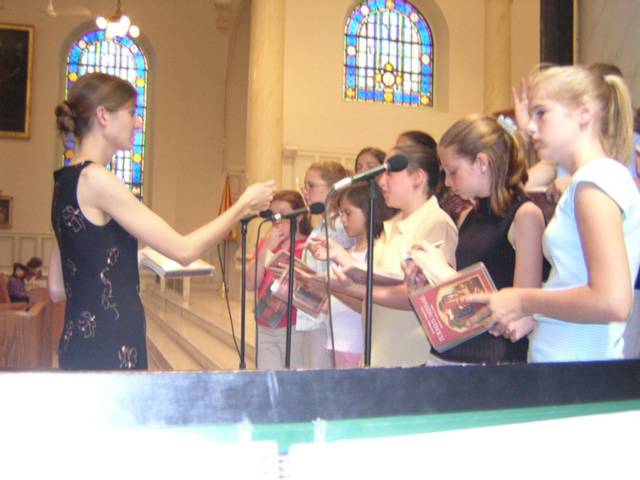
choir Posted by Hello

Amy and cantors Posted by Hello

Amy and choir Posted by Hello

ladies Posted by Hello

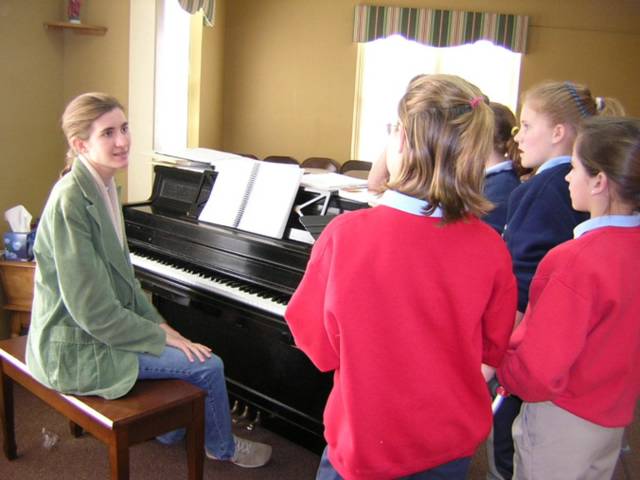
St. Joe Youth Choir  Posted by Hello

The choir's Memory CD is named "Sure as the Wind"

1. Thy Word is a Lamp
2. Fly Like a Bird
3. Morning Has Broken
4. For the Beauty of the Earth
5. Alleluia, Sing to Jesus
6. I Will Choose Christ
7. Alleluia Word of God
8. Lord of the Dance
9. Celtic Gloria
10. You Are Mine
11. Sing Out, Earth and Skies
12. Christus factus est
13. With One Voice
14. Spirit, Come
15. Sure As the Wind

The last rehearsal for the school year was a party, of course. Snacks and listening to a CD of their music.

One interesting tidbit. The music was loud, and we were talking, and someone was even playing on the piano. Then Christus factus est came on. Two or three girls jumped up to stand next to the speakers to sing along. Others joined in--maybe half the group. This is the only piece that got that kind of reaction.

Tuesday, May 25, 2004

Q & A

I received a really nice email this morning from Louisiana. It asked me some hard questions, and since I just spent the morning trying to compose brief answers, I think I'll just post the letter.

------------------------------------
Dear friend,

So nice to hear from you. What an opportunity you have, to be able to fill a need and possibly have the chance to sing this beautiful music in liturgy.

I firmly believe "If it is liturgy, it is to be sung." We teach that the mass, even when it's celebrated simply, should always have:
A gathering song that involves all the people
A sung/chanted responsorial psalm
A sung gospel acclamation
Sung acclamations to the Eucharistic prayer (Sanctus thru Doxology)
A communion psalm, song or hymn.

I think this pattern would be true for the Tridentine mass as well, don't you? And if you are starting up in a church where people are not accustomed to singing, you wouldn't be bound to the practice of singing the variety of ever-changing liturgy that characterizes a more mature singing situation. I would take advantage of the common psalm approach.

You ask me questions that it would take a book to answer. I'm not an expert, but a seeker. Be aware that my answers are colored by these considerations:

1>Recent research gives us clues to a rich understanding of chant that might be different from current practice. This, combined with knowledge of cognition and social development, takes me to an exciting place. Much of the literature on chant is written without this knowledge.

2>I believe strongly in the chant heritage of the Catholic Church as fundamental to all parish practice, including the renewal of liturgy since Vatican II. So I'm not working to reinstate the Tridentine mass. I want us to connect to our roots in scripture and liturgical music.

3> Now that I've "unlocked" the code, singing chant according to ancient practice is pure pleasure and powerfully meaningful.

Given that introduction, I go to your questions, which were an enjoyable exercise for me this morning. Thank you.

> > 1. Do reliable instructions exist for singing from St. Gall neumes?


First, look at Chant Made Simple by Robert M.Fowells.

The definitive source is supposed to be Gregorian Semiology by Dom Cardine, but I have yet to get my hands on the book. Fr. Columba Kelly, at St. Meinrad Archabbey in Indiana, has studied this extensively, and he provides many materials in his seminars. I highly recommend his two-week summer seminar at the abbey. (But you have young children, so maybe it should wait.) I don't know how you found me, but I post my experiences to the web at http://randomlight.blogspot.com/ and hope others will add their experience to it.

> > 2. What information do these neumes convey that the square neumes cannot?

Square notes give us pitches. They do not tell us how to sing those pitches.
The first source of HOW to sing is neither the pitches nor the neums, but the text. The chant is an extension of proclaimation of the text, based first and foremost on the natural accent of the words.

The St. Gall neums also record pitches, but not in the sense that we are used to, and we aren't able to read this until we have a lot of experience singing and "know" the forms. The academic resource for this concept is Alberto Turco's "Gregorian Chant" Tones and Modes, Edizioni Torre D'Orfeo, Roma 2003,

All research agrees that Gregorian chant predates the concept of the "beat" in music, and that neither square notes nor neums are intended to imply mensuration (or marking off, counting) of time elements in the music.

The neums DO tell us relationships, including shorter, longer, emphasized, held-out. These relationships are not based on a hypothetical "beat", as we are used to today, but are based on the spoken accents of the text.


> > 3. How do you use these neumes?

I use the neums and the square notation to decode a historically-informed rendition of the chant.

First: translate the Latin text. Even better, know its context(s).

Next: Make sure I know which syllables are accented. Underlining them is not a bad idea. It's surprising how often I "read" modern tonal emphases into the chant and only detect my misunderstanding when I look back and re-emphasize the word syllabication.

Next: sing the piece according to the neums and the square notes. At some point here, I find it helpful to sing solfege. Again, it is a check for mistakes in intonation.

I use these pieces as meditation, so all the above considerations are secondary, but if we plan to teach and share the music, I think all those factors are important.

When I teach chant to choirs, I prefer to give them the text and the St. Gall neums (which I copy onto a sheet). I ALWAYS give them the oral (call-and response, text-and-meaning-based) experience of the chant before I give them notation on paper.

> > 4. How do they lead you to sing square neumes differently?
Every chant recording I can find has an unspoken, often unrecognized commonality, in that the separate square-note pitches are relegated to a measured identity. There is a flow of either steady notes, or a combination of duples and triples.

I don't do this. You would have to hear the recordings and look at my scores to get a feel for the difference. I simply DO what the scholars teach. The recording are on the www.iglou.com/watchmakerpress/chant/ChantIndex.html. I'm posting manuscripts in standard notation at www.SibeliusScores.com.

I'm sure they are not definitive. I do NOT have the years upon years of study that are necessary to decipher each nuance. But they may be the first place that this concept is actually carried out.

> > 6. Who else uses the Graduale Triplex , that you know of?

A Louisville group--Evensong--sings a weekly Compline service at the Chapel at St. Philip. They sing chant with a similar understanding, but their repertoire is more Anglican-based. I should talk to them and find out their resouces.

Who uses it consistently in liturgy? No one in my personal experience. We do not sing (or say) the latin mass. I'm parish Sunday-mass based. We sing chant regularly, but melismatic chant only occasionally.

I'm carefully studying my options for starting a Schola Cantorum St. Joseph Proto-cathedral, but I haven't made the move, yet, so I'll be VERY interested in your experiences. You're invited to post them to www.randomlight.blogspot.com. There are always places for comments. Or if you email to me, I'll post what you send me.

Thank you for an enjoyable morning. Please stay in touch about your experience.

In Christ,
maggie hettinger

-----------------------------------------------------------------

So, basically, I'd like to offer the same invitation to anyone else. If you find it meaningful to explore the treasures of historically-informed chant style, please share your experience--no matter how small.

We are at a nexus. The butterfly's wing can change the world.

Fr. Columba told us that when Dom Moquereau at Solemnes gave out the information that became the "Ward System" of chant in the U.S. American Catholic School systems, he knew that he had not yet unlocked the meanings of his own research. He gave them an approximation that they could use, because they had the funding and wanted to move on it NOW.

I find it interesting that when I teach chant to parish choirs, unlike those who already sing chant extensively, they don't hear the "difference." They say things like: I can hear the sounds of my childhood. I can hear the monks. I can just hear (Father ____).

So, maybe this 40-year hiatus of chant in our church is not totally bad. We get to pick up again with the advantage of expanded knowledge, and without the memories of Sister Mary Holywater beating out with her pointer (or even worse, a "clicker") the thumps and bumps that found their way into the Ward system of learning chant.

I'm excited.


Monday, May 24, 2004

O'Reilly Network: The Fuss About Gmail and Privacy: Nine Reasons Why It's Bogus [Apr. 18, 2004]

O'Reilly Network: The Fuss About Gmail and Privacy: Nine Reasons Why It's Bogus [Apr. 18, 2004]

I like Google. I like their attitudes, their capability, and their ability to follow a high-Quality path. They seem to bringing a LOT of people along for the ride. The number of organizations that I see doing THAT, I can count on the fingers of one hand.

I'm trying out GMail.

Sunday, May 23, 2004

New Score: Ascendit Deus

"Ascendit Deus in iubilationem Dominus in voce tubae, alleluia"

I can't believe what I discovered the other day! A piece of chant that's as evocative as a film--big-sky effects, trumpet calls, real jubilation.

It's Ascendit Deus, Offertory for Feast of the Ascension, Graduale Triplex 237.

I am CONSTANTLY being surprised.

It's not what I ever expected to find in Gregorian Chant. Wow. But I didn't make this up. It's really there, in the notation. I hope I can convince a good singer to try it. (Maybe Alan.) I love singing it, but I doubt I could ever pull it off in public. WHAT A PIECE!

I wrote this one up in standard notation. It wasn't as hard as the first two I worked on. It's published on SibeliusMusic.com.


It's listed as:

Ascendit Deus
An expressive chant for singer(s) in a reverberant space.

I'm thrilled with this find. I'll try to record it soon.

Thursday, May 20, 2004

Random

What, in our experience, is actually random?

A card drawn from a deck?
The roll of a die?
An accident on the highway?
A conversation with a stranger on a street corner?
Really? Is it random?

What today was random?

Chant at St. Joe

I went to rehearse Spiritus Domini with the St. Joe choir again tonight. Debbie was rehearsing One Spirit, One Church / Come Holy Ghost when I got there. It was a big sound, with organ, handbells and full choir. We'd practiced the same piece with Youth Choir, and the kids also sing it well.

So, when we started, I quipped that we were shifting from many voices and many instruments to one voice. While people were finding their chant music, we sang sol---->slide down to do (on "lu.") I kept it on one pitch, G to C, which is where we will sing the chant. It was a quick way to make the transition to chant sound.

Using our rehearsal sheet with the words and the St.Gall neums, we reviewed the antiphon. It was a mixture of call and response, short phrases, joining to longer, some solfege explanations. We sang it all the way through several times. It was REALLY exciting that we were doing this in church, and, even though folks aren't really comfortable with singing the whole antiphon thru yet, they ARE comfortable enough to sing strongly and clearly on the phrases as we did them. And we could hear those "sound effects" such as the harmonies that tuck under the ringing repeated tones. And the choir is making a beautiful sound.

After a bit of this, I admitted that I knew they were less-than-comfortable not having "real" music, and I passed out the modern-notation version (see last post). I got some relieved-sounding "thank-you"s as they saw the notes. We sang thru the antiphon from this sheet. I don't know why I only had them do it once, and I wish we'd done it twice. My mistake.

Interesting, although they were happier to have the notes, it completely threw off our phrasing, our style, our accenting and word-emphasis, and it really threw off my conducting. We were seeing individual notes. Still, I should have done it twice. Instead, I reacted by saying, "You have this for reference, so you can remind yourself how it goes, but we'll sing from the neums." And I took us immediately back to the other sheet, and we sang again.

Next week's rehearsal, I plan to return to the words of the text and the translation, moving us off the piece of paper as much as possible for the antiphon, singing the psalm verses and Gloria Patri from the sheet. They should be ready for it all to click. We'll then have one more rehearsal before mass on Pentecost. I think we're ok. First time singing melismatic chant. Pretty good, considering we're boot-strapping all the way.

I LOVE that chant.

Spiritus Domini
Spirit of the Lord fills the whole earth.
replevet (replete. fat, bursting with fullness, brimming over, ever re-filled)
orbem (the orb of our Earth Why is "orb" so pregnant-sounding, so live?)
terrarrum. (Tara. Gaea. Sophia.)
Alleluia!!!

et hoc (and THAT)
quod continet omnia
that which contains all things, directs all things, maintains all things, sustains all things,
alpha and omega--THAT
has knowledge of language,

THAT
understands words
(scientiam habet vocis)

THAT prime mover / BIg Bang
....evolution
..........physics
................biology
......................sociology
...........................dynamic Quality
...................................THAT has VOICE.

Alleluia, Alleluia, ALLELUIA!


Tuesday, May 18, 2004

DVD: Brother Sun, Sister Moon (1972)


Amazon.com: DVD: Brother Sun, Sister Moon (1972)


I watched this the other night. (not the DVD, but the video, which I found in a closet I was cleaning.) Fascinating.

This is the Zeferelli version of the story of St. Francis of Assisi, full of heavy-handed imagery, gorgeous costuming and scenery, flower-power music, anti-establishment attitudes, constant references to the (at the time) new mass liturgy.

It was hard to watch. The dialogue and plot felt unbelievably mushy, gushy, trite, and banal.

BUT, it was a strong reminder of the time in which it was made, and this was enlightening. The music was sung by Donavan, who was my favorite singer during those years, and I still liked to hear him again, for all the same reasons.

The movie strongly associates traditional liturgical music with evil, and that's a little hard to take. But again, it's a reminder of WHERE WE WERE at the time, and how much we've learned. Also how much we've forgotten, and why the church has to speak from all our experience, old and new.

The phrases that seem so trite to me now were fresh in '72. The message--down with the pomp, down with music that no one understands, up with the core messages of Jesus, up with personal commitment--these were new to the baby boomers and their parents. The core concepts contained in this film were life-changing. They still are.

As the Buddhists are said to say, "The finger pointing at the moon is not the moon."

Friday, May 14, 2004

Two Expressive Chants for Pentecost in modern notation

I've been working on a modern-notation version of Spiritus Domini and Factus repente. I've uploaded the score to SibeliusMusic.com. The title is Two Expressive Chants for Pentecost

Cover notes:

Rhythm:
This is an attempt to render the highly-expressive Laon and St. Gall neums to familiar notation. Therefore, rhythms are approximate. Bar lines are included so that we can see “pick-up” and leading phrases. THERE IS NO BEAT in Gregorian chant. The rhythm flows around the accented syllables of the words.

The accented syllables are marked by underlines in the scripture text above the music.

To begin to understand the piece, first practice speaking the text with clear accented syllables, then speak it again, broadening the sound to orate (proclaim) the text. Your chanting should be very similar to this oration of the Latin text.

Pitch:
In general, chant is not restricted to any pitch, but can be sung in whatever range suits the singer(s). However, in Spiritus Domini, there is an appropriate pitch that depends on the space in which the chant is sung. Many reverberant churches have a particular pitch that resonates well throughout the building. You can set C (do) of this chant to match that pitch.

The asterisk (*) in the notation points out a pulsing on the reverberant note, which, when let ring, offers a kind of harmony special to chant. The pulsed note sets the worship space ringing, at which point the singer drops to another “part,” tucks in the harmony notes, and then returns to pick up the pulsing, ringing tone and carry on. This effect can be experienced with the words replevit, terrarum, and scientiam.

Factus est repente has its own "special effects." The opening phrase can be sung strongly, starting with the open fifth and leading to the word sonus (sound) which can be echoed thru the church. Notice that the words ubi erant sedentes (whereupon it settles) are set to a drifting, peaceful melody--much like leaves drifting from a tree, or a feather on a breeze. This effect can be sung again in magnalia Dei. I'll leave you to extract your own meaning from that.

The liturgical chant of the Graduale is some of the most meaning-filled, prayerful music I have ever encountered. I encourage you to discover the original sources, and learn to sing from the ancient, expressive, yet simple neums recorded in the Graduale Triplex.


"The Gregorian repertory is a complex world which unites several centuries of musical history. It is in fact a world of astonishing variety which mysteriously approaches nearly delirious enthusiasm as well as the most delicate interior things. It is a paradoxical world where music blooms in silence."
-- the monks of Solesmes
at http://www.solesmes.com/anglais/ang_solesmes.html


"The pure echoes of the chant can touch the hearts and minds of all who are fortunate enough to sing or listen to it. Conceived in humility and expertly and lovingly crafted over centuries, chant is our heritage, and should be allowed to live and breathe as it was intended, in liturgy. It ought not to be relegated to the concert hall where its beauty can be only half realized, as there it can point to no mystery beyond itself."
-- Arlene Oost-Zinner and Jeffrey Tucker, from the February 2004 issue of the Homiletic & Pastoral Review


One way to bring this music into the Liturgy would be to sing Spiritus Domini as a prelude to the gathering song, and Factus repente after the Communion procession and song.

For more suggestions, see Watchmaker Press Chant Index.


Creative Commons License

This work is licensed under a Creative Commons License.


Thursday, May 13, 2004

Chant at St. Joe

Amy and I held a "recording session" with Youth Choir to make a memory CD for them. They sang Christus factus est (recording here), and I was really pleased at how well they all remembered it. They learn melismatic chant MUCH, MUCH more easily than adults. I think I'll add the recording to the Chant Index.

---------

Rehearsal with the adult choir went well, I thought. We rehearsed Spiritus Domini in church. We:

* touched briefly on how everyone thought Regina Caeli went last Sunday. Comments were positive.
* rehearsed the translation verse, english verses and Gloria Patri, mentioned names of neums, touched on the phrasing of the neums (stronger on the first tone, comparable to singing a two-note slurred passage in modern notation).
* (I had hoped to rehearse the three alleluias of the antiphon, but ran out of time. We have two more rehearsals.
* I sang the antiphon, asked whether they were starting to hear the music in it, starting to see what's notated.

---------
One choir member, Rose, had said something to me Sunday, about "We are used to having notes." Of course, I know that all of us American church musicians (and everyone in general) have let our oral/aural skills atrophy. I'm not trying to make anyone uncomfortable.

I'm convinced, though that "sacrament" has something to do with using our somatic and mimetic cognitive patterns to interact with the somatic and mimetic cultural web. So I'm sticking to an emphasis on oral transmission and imitation.

However, that doesn't mean that as we bootstrap bringing chant into parishes that we can't use all tools available. So, before rehearsal, I had put in some time making a "standard-notation"version of Spiritus Domini. I didn't give it out, though. I might. I might not. It was an interesting exercise for me, and might be conceptually useful, but NOT NOT NOT NOT as a starting point.

Wednesday, May 12, 2004

Left Behind: A Novel of the Earth's Last Days

Well.


I've just read the first book in the "Left Behind" series.

Left Behind: A Novel of the Earth's Last Days (Left Behind No. 1)

It was interesting (and it also was very good at putting me to sleep). The interesting parts are:

1> The exploration of the "born-again" experience. I can relate to this on some levels, but still find the Fundamentalist Christian context very foreign and uncomfortable.

2> The question of How much does this series (and the movement surrounding it) have to do with our President's irrational fixation with Iraq? I've only read the first of this set of novels, but it looks as if the Anti-Christ and his world-government are setting up in Babylon (50 km s. of Baghdad, Iraq), and the characters are all set up to fight his evil influence and replace it with the Kingdom of Jesus.

I thought Bush's fixation had to do with his oil background, but this, crazy as it is, fits the facts better. The man (and how many around him) is living a super-hero religious fantasy. And thousands upon thousands of Iraqi people are dying because of it.

Monday, May 10, 2004

Sunday I conducted St. Joe choir in Regina Caeli at Preparation of the Gifts.

So, you say, what's to conduct? Well, actually, there's a lot. Even though it's not melismatic like the chant in Graduale Triplex, once you've entered the idea that the speech patterns are the source of rhythm in chant, even the hymns are richer, BUT, it takes real work to keep singers from dropping into the sing-songey "I CAN ac-CENT an-Y syl-LAB-ble, CAUSE I DON'T know WHAT it MEANS" singing that we learned as children.

Did I conduct every syllable? Sometimes. Not always. That makes it difficult because unlike measured music, you can't assume beats (and therefore sub-beats) being in a particular position. Without that, how do you differentiate between conducting each syllable and conducting only the accent? Arsis and thesis don't help any. Pitch indication is part of it, but it's not enough.

The choir sang well. Here's the recording. The only real mistake was mine. I asked the organist to play a C drone as we sang, but I didn't choose a good stop (probably not enough treble), because people (depending where they were standing) couldn't hear it, and we dropped a hair. Only a hair, but without the organ, no one would have known. Aah, maybe they didn't anyway.

-----------
Today I'm working today on two things--cleaning up from my Laura's graduation party, and trying to lay out an education program for chant & liturgical music. I'm focusing on three things:

* The suggestions for forming a Lay Apostolate for chant
* Some sessions where several music directors were invited to the Archdiocese of Louisvlle Office of Worship to help evaluate and re-think the Liturgical Music Certification Progam
* Outcome-Based Education, which builds community and works equally well in formal (taught), informal (mentored), or self-directed education.

It's not as easy as I'd first thought it would be. So many angles, but there ought to be a way to make it simple and somehow obvious that it is advantageous to any Catholic parish. Or maybe to any Catholic musician. That's not the same angle, either.

I had a real shock when I Googled "Novus ordo." I have used that phrase to refer to the Latin text of the current mass. (See Novus Ordo text. ) It is a beautiful liturgy belonging to the universal Church. We sang it in Rome with Fr. Sorgie.

I had no idea of the existence of horrible, angry, ugly groups of people who use the same phrase as a code-word to heap invective on all things post-Vatican II. My stomach is still in knots just from looking at some of the web sites. Really ugly.

It's an ugliness that probably prevents us from using the word. So, where I had formulated the objectives as these:

o To encourage the singing of liturgy
o To promote and maintain the learning and singing of Gregorian chant within Catholic parishes
o To facilitate mastery of the fundamental musical skills required by Catholic liturgy and rites, including the Novus ordo Eucharistic liturgy.
o To develop, nourish, and support a lay apostolate formed by the experience of sung prayer

Maybe that third objective will have to be changed to

o To facilitate mastery of the fundamental musical skills required by Catholic liturgy and rites, including Latin as well as English

I'll keep working on it. I'll have to stop now, though. The Holy Name Band is playing at Christopher East nursing home tonight, and I'm not sure where my flute is, even.

Friday, May 07, 2004

Confessions of a Recovering Choir Director: A lay apostolate for chant?

Fascinating concept: A Lay Apostolate for Chant
http://www.cantemusdomino.net/blog/archives/001004.php#001523

Anybody in the Louisville area interested?

Thursday, May 06, 2004

Paul Rex notes an article of which I want to record a few sentences.
(See his blog http://xprex.stblogs.org/archives/014847.html for more.)

"The pure echoes of the chant can touch the hearts and minds of all who are fortunate enough to sing or listen to it. Conceived in humility and expertly and lovingly crafted over centuries, chant is our heritage, and should be allowed to live and breathe as it was intended, in liturgy. It ought not to be relegated to the concert hall where its beauty can be only half realized, as there it can point to no mystery beyond itself."

-- Arlene Oost-Zinner and Jeffrey Tucker, from the February 2004 issue of the Homiletic & Pastoral Review

Monday, May 03, 2004

Well, here's a fascinating wake-up for me. I thought nobody else was trying to sing chant in parish churches. Here's an obviously long-running blog with lots of people involved. Guess I'll check it out regularly.

Confessions of a Recovering Choir Director

An Introduction to Gregorian Chant
by Richard L. Crocker says this:

"When a solo voice intones a prayer, or a reading from Scripture, on a reciting pitch, the intonation on a single pitch can result in extreme resonance. The natural ability of the human voice to speak directly to our inner hearing is maximized with intonation and the resonance that it brings. This has a special application in Christian worship: when expressed by a strong clear solo voice, with the resonance reinforced by cathedral reverberation, this kind of intonation can penetrate the listener's heart, seeming to convey the truth of the words of doctrine.

"While a solo voice on a reciting pitch has the power to penetrate the listener's understanding, the sound of a chorus does not so much penetrate as envelop, gathering up the listener into a larger unity. The sound of the whole congregation intoning in unison is like no other musical experience. Unison singing by everyone is not just a 'symbol' of being together, it is an archebype, a primary experience of being together, one of which other experiences may be symbols.

"When psalms are sung this way in a reverberant acoustic space such as a cathedral, the reciting pitch builds up a very great resonance -- especially if the singers find the reciting pitch specific to that building, the particular pitch that resonates most strongly in it. As the sound continues minute after minute, it permeates the whole space and everyone in it. The walls reverberate, the building itself seems to reproduce the tone. Certain medieval churches have this effect to a remarkable degree, and recordings have been made that show an extreme development of the overtones produced by such resonance."


I'm interested in both his description of a performance technique and a primal experience of unity. We experienced the unity at Holy Trinity, where, during Ordinary Time, we chanted the Gloria "a capella" for over a year. We used that simple setting from John Lee's "Congregational Mass" (c) 1970, GIA. #254 in Gather Comprehensive. I wonder if they're still doing it? After I got out of their way, the microphone-hungry Karoke elitists came out in force again, (at least that's what I hear, and I don't ask).

St. Joseph Proto-Cathedral in Bardstown is now working on installing a very expensive sound system that counteracts the reverberation of the church to accommodate the modern Catholic mass. (Several speakers in each pew, and that IS what you need to sing the "Catholic Pop" style effectively in the older churches. I can't knock it too much. I'm an expert at "Catholic Pop" music) I hope that my exploring chant with the St. Joe choirs can help us all understand that the characteristics of that building are not just a disadvantage. I also hope somebody sees the need to put a switch convenient to the choir loft that lets the system be turned OFF.

Back to Crocker, I'm especially interested in that primal communication, that primal experience of unity that he described so well above.

The meanings of the Latin chant are stored in something that predates and is foundational to our Western languages. We probably still have the keys to unlock them, in areas of our cognition that are largely unrecognized, except what is exploited by mass-media advertising. I have no doubt that advertising keys in on the same space. The difference is the message.

I've always wondered to what extent the great prehistoric cave paintings are also associated with reveberant acoustic space.

I just ordered
Primer of Ecclesiastical Latin
and Dictionary of Ecclesiastical Latin

Maybe I should talk to Barry and Judy (ArchLou Office of Worship) and tell them that I'd like to work with a parish develop a simple mass (Sunday, weekday) that is characterized by vocal music--Gregorian Chant and familiar songs. Just a phone call. Why not make it?

Friday, April 30, 2004

I spent the day cleaning and painting, so I had lot of time to listen to my recordings in iTunes. A lot of them are chant.

I was reminded several times of how differently the Schola at the Saint Meinrad Archabbey sings than the other recordings. The difference in is the expressiveness in accent of the syllables.

This is Fr. Columba Kelly's influence and conducting. They are singing from the Graduale Triplex notation.

BUT, even St. Meinrad singers are still locked into that measured square-note orientation, in which each square note lasts for one or two of whatever the basic measure is. Yes, they start phrases more slowly, speed up a little toward the center, and slow down again towards the end, but it's still measured.

Dom Turco does the same thing. He SAYS that the chant has no relationship to measured notes, but he sings it that way. (We had a fifteen minute conversation on the subject, but I dropped it when we were just getting frustrated.) Great man--Dom Turco. I appreciate his knowledge and enjoy his enthusiasm and love for the music and the prayer.

I did hear, ONCE, on a recording, a monastery schola sing an antiphon in which the last phrase of the antiphon was sung exactly as I would sing it. Probably it was something like do-re-mi--re-do-re-re--do--. That one tiny ending of a phrase, and DID IT SPARKLE.

So, I keep listening for someone else to interpret the Semiology as I do, and as the teachers (Kelly, Turco) teach in their classes.

And I keep hoping for a situation in which I can experience singing Latin and English chant at regular liturgy. I think it would be WONDERFUL at weekday masses. We could sing a little of the chant (Latin antiphon and English psalm), chant the acclamations in English or in Latin, and still sing a familiar hymn or song.

I found this statement on the Gregorian Chant page of the Abbey of Solesmes. It said: "At first hearing, Gregorian chant might seem monotonous. Undoubtedly it disconcerts our modern ears, accustomed to more contrasted music, but often less profound. In reality the Gregorian repertory is a complex world which unites several centuries of musical history. It is in fact a world of astonishing variety which mysteriously approaches nearly delirious enthusiasm as well as the most delicate interior things. It is a paradoxical world where music blooms in silence."

Is there any way to enter that world? I'm married. I have children and responsibilities. There's no monastery in my future, not even seminary. But I am drawn to enter that world.

Also never hear another television crime show as long as I live. That would be ok.

pax,
maggie

Wednesday, April 28, 2004

Tonight was chant rehearsal at St. Joe. 2nd session. 15 minutes.

First we "warmed up" for a chant sound with ooh(do)-ah(sol-----fa mi re do). Start on D, sing up, then down. Worked for a dark, blended sound. Then sang a series of pitches from Kodaly hand signs, just a few. About six choir member hadn't been there the week before. I told them that we'd be singing things that we couldn't explain, but just sing along, and don't worry if you don't catch it all at once.

We started with Regina Caeli. First we spoke the words. I pointed out the raised inflection on the accent, which we tried. Mentioned that in the past, some people had advocated that there was no stress accent in Latin chant, ONLY the raising of the pitch. (Justine Ward seems to have advocated that.) Some folks still read in a monotone. We didn't work it, just moved on. As I got ready to sing, I remembered that we had warmed up with Kodaly signs, so maybe we should sing the pitches that we worked on so hard the week before. So we did: do re do re mi... After that, we sang thru the song, only stopping to notice the double square notes and make each one a distinct sound.

This was ok, but next time we should sing pitches first, then speak the words. Reading the pitches put equal measured metrics in folks' heads, and we never got back to the more fluid speech-rhythms. Next week will be the week before we sing at mass. I'm going to have more of a conflict than I thought, with Laura's graduation the same weekend, so I think I'll call Debbie about whether she would be comfortable conducting this one.

Spiritus Domini, I gave out a revised sheet to read from. I reminded the new people that they might not get it all, and don't worry. We actually sang only the first line. Worked on dynamics a little and separating those repeated tones. Didn't get enough melody-singing, so that they will be familiar enough with the music.

The new sheet includes a copy of the Graduale Triplex page on the back side of it, so folks will have the square notes if they want to look at them. I also included the address of my Chant Index page, and told them they could download a mp3 of the chant.

Next time, we have to sing more. Just sing it. I'll refrain from working anything except the last three alleluias.

My conducting technique (lack of it) is driving me crazy. The St. Joe choir folks are really polite, and they sing well, but I feel like I should apologize with every gesture. I practice all the time, but it's really awkward to decide what moves should be there. I use a combination of pitch clues and motions that resemble the St. Gall neums. Problem is, some of the neum combinations go too fast to conduct them all, and then I'm switching to a version of conducting toward the syllables, with some references to individual neums, mostly when there is a repeated pitch.

It is better since I figured out that I was conducting "backwards," but I haven't internalized all that that changes, yet.

I think I should take slower tempos on the notes next time. I think I'll rehearse the last three alleluias, then just have us sing thru antiphon and verses.

After my 15-minutes was up, I thanked them and went home, and instead of going to the empty house, pulled in Bernheim Forest and went to the silo. I sing there a lot, but usually very early in the mornings. At that time of evening (7:30 pm) there are people there, but I went ahead anyway and worked on chant. They hung around to listen, and it didn't feel awkward. I think I'll do this every Wednesday night after practice at St. Joe. That will make the trip worthwhile.

OH, and this afternoon at Amy's youth choir practice (the St. Joe Youth Choir), a couple of 8th graders came up to say they needed to have a quick conference about medieval music, and I could tell them that "Christus natus est," which they sang on Palm Sunday and Good Friday, was early music, as is Regina Caeli, which they are also learning to sing. And wouldn't you know, they needed info for a class presentation tomorrow, but none of us had copies of the "Christus factus est" sheet that they'd learned from. We copied the page from Graduale Triplex, but I suspect it's too complex-looking. I wonder what they'll do with it.

Actually, I have the sheet posted on the internet, here. Why didn't I think of that? I could have told them how to download it, but it's not listed in the index yet. Oh well, too late, it's almost midnight. But it's neat to know that this information posted on the net CAN be useful.

And I guess I'd better update that index.
ChantIndex.html

Tuesday, April 27, 2004

This morning I sang the Exsultet for morning prayer. When I sing it as my morning prayer hymn, I don't usually get back to the rest of the regular morning prayer, but that's probably ok, esp. during Lent and Easter.

Thinking about that, I have some procedural things nagging at me.

One is that so many people have said that the Exsultet is "that long boring thing." How many parishes cut out half of it, usually using those horrible cuts in the missal that take out all the transcendent verses? Wouldn't it be better to move toward a more speech-based rendition, which converts those long, time-consuming "notes" into inflections? It would cut out at least one-fourth of the length, I bet.

I think I'll add that to my list of things to record. I've never heard it recorded that way, but it would be much more palatable to modern listeners, especially in non-acoustic settings.

My second reflection is about something that came up in the conversation at Sarah's First Communion last Saturday: namely that the priest is NOT supposed to sing the Exsultet at the Easter vigil. They said it is supposed to be the deacon, and if not the deacon, then the choir or cantor. I didn't think that was true, so I looked it up, and made a call to Rosemary at the Office of Worship to make sure it hasn't been changed.

The missal says that the Exsultet is sung by the deacon, or if there is no deacon, the priest. If necessary, the Easter proclamation may be sung by one who is not a deacon. In this case, the bracketed words [My dearest friend, standing with me in this holy light, join me in asking God for mercy, that he may give his unworthy minister grace to sing his Easter praises] and [The Lord be with you] would be omitted.

Why I, as cantor, can't ask for grace is way beyond me, but anyway, if parish musicians are getting bent out of shape because the priest wants to sing the Exsultet, they're all wet.
---------

Last night, the Holy Name Band played a concert at the Chapel of St. Philip (formerly St. Philip Neri Church in Louisville). I always like to go there. St. Philip Neri was closed at the same time St. Clare was supposed to have been closed. St. Philip has continued as a chapel, with regular morning and evening prayer, and a wonderful, well-attended Compline service on Sunday evenings (sung by Evensong).

I mention well-attended because Bob says his attendance at morning and evening prayer has fallen off, though it continues. (Been there, done that.) What does it take?

We were talking about how many people use MAGNIFICAT, and he was wondering why we can't make a connection to those folks. I was looking at an older copy of Magnificat, and thinking, what a nice venue for formal morning prayer with chant? Add two Latin antiphons, for the psalm and for the Canticle. Print them on a small card for those who'd want to pick them up. Be sure to have an extended prayer of the faithful, with personal contact. And probably do this 1/2-hour before mass.

Monday, April 26, 2004

I think I had a breakthru the other night. I'm struggling with "how" to conduct Gregorian Chant. Fr. Columba says that there's a close relationship between the St. Gall neums and the movement of the conductor. I've been taking that as my starting point, and the correlations are there, and possible.

BUT I was conceiving the movements as I see them on the paper. Last night, driving down the interstate, conducting, I realized I'm doing it backwards. The motions have to be oriented so that the CHOIR sees them as they are on paper (not literally, but as a starting point). And, this feels MUCH MORE RIGHT.

I'll try this with St. Joe Choir on Wednesday and see what happens.

I'm also reading Justine Ward's introduction to the Catholic Education Series 4th-year Gregorian Chant. I'm surprised at how insightful this is for conducting, (even though we often say that "historically-informed" chant is a different animal from the Ward method that was taught in Catholic institutions before Vatican II). There's nothing stodgy or metrical about this woman's description of conducting. I wonder how many of the 50's era teachers actually read the material?


Friday, April 23, 2004

It's pouring outside again. This morning I'm going to spend some time getting Fr. Pat's homilies online. I'm using another blog: "A Catholic's Companion." I'm going to start with the Easter season C homilies "The Spirit and the Bride." The blogger format looks promising for this kind of thing.

I feel as if Fr. Pat's homilies comprise a seminal work that deserves to become part of the mind of the new millennium. Here's what I wrote in the introduction of the book. It still seems as true as it did 3 years ago:

------
As a Kentucky diocesan priest, Fr. Pat Creed placed his life in service to the transformative power of the liturgy of the Roman Catholic Church. To this service he has brought energy and intelligence, a commitment to community action, and a wonderful gift for storytelling and preaching. The soft-spoken intensity with which Fr. Creed inspired listeners is difficult to capture in print, even more difficult to capture outside the liturgy within which the homily is an integral part. Within a broad range of challenging topics, listeners are taken, by his surprising scriptural knowledge and pervasive sense of community, to a point in which each person's own life is brought into question. No matter our backgrounds or expectations, we in the assembly always knew he was speaking directly to us, and by the end of the homily, had transformed some aspect of our own lives, changing our patterns according to the Gospel vision of God's love for us. This transformation was the gift we brought, together, to the celebration of Eucharist, week after week throughout the liturgical year.

Even more valuable to us now might be a glimpse of the processes that formed the speaker. While eagerly grasping the Second Vatican Council's renewal of the liturgy and structures of the Church, Fr. Creed maintained his commitment to its traditional forms and practices, privately and publicly adhering to the Divine Office (the Liturgy of the Hours) and the integrity and centrality of priesthood.

Pope John Paul II has recently reminded us that Vatican II's renewal is really just begun, and has called for evaluation of the Church's direction within it. While this evaluation will certainly take place in meetings and conferences worldwide, this documentation of Fr. Creed's homilies is offered as the culminating record of lifelong evaluation of Vatican II, an evaluation that brings millennia-old voices of the people of the psalms and scriptures into weekly dialogue with the present and future People of God--voices transformed and re-stored by the action of the liturgy.

Yours in Christ,
Maggie Hettinger, editor

[Introduction of "A Catholic's Companion" Selected Scripture Readings of the Church Year with Homily Reflections by Rev. C. Patrick Creed Liturgical Cycle C (c)2002 C. Patrick Creed]
-----


Thursday, April 22, 2004

The Holy Father is speaking on Vespers at his Wednesday audiences.

Zenit News Agency - The World Seen From Rome


The above is a web site that carries all the Holy Father's Wednesday messages. (Amy and I heard one of them, last January, from the roof of the Residence Paulo IV)


Last night's "Introduction to Gregorian Chant" session with the St. Joseph Proto-Cathedral Choir went well, I think.

It was informal. Debbie (director of music & choir director) had invited me to choose a couple of pieces that the choir could sing--Marian, perhaps on Mother's Day (5 Easter), and Pentecost.

I brought Regina Caeli and "Spiritus Domini."

For Regina Caeli, I copied the page from Night Prayer (STTM). I checked in Liber Usualis for the accents of the Latin, and marked them in before I made the copies.

I made a handout for Spiritus Domini, including translation, pronunciation, an english translation verse, verses from Psalm 68:4-7, 10-11, and Gloria Patri. I included St. Gall notation for the antiphon and verses, but deliberately did NOT give them the square notation for the antiphon. My objective was to let them experience oral transmission and the St. Gall notation. I think it worked well.

Debbie rehearses with the women of the choir at 6:30, and the men join them at 7:00. She asked me to come at 7, and take as much time as I wanted. I decided to aim for 45 minutes for a good introduction. (I didn't take my watch, and actually used an hour and a quarter. That was a little long, but the content went well. In the future, I might plan to use that amount of time, just prepare folks ahead of time, and take a quick break in the middle.)

Debbie introduced me. FFR: mention Fr. Sorgie, Chant Institute in Rome, Fr. Columba Fr. Columba Kelly, Morning & Evening Prayer.

I told them that my experience with chant centered on new research, "historically-informed," in which the chant is more closely related to speech patterns and earliest notations than the way I had learned as a child in school. I said that what we learned could still be sung in the way we had sung before, if we wanted. The chant repertoire has been sung in many styles over the millennia, and all of them are beautiful & meaningful.

I asked the choir members to tell me their names and to share their past experience with the chant. Most had some previous experience. If they were my age or older, they had sung in school (pre-Vatican II). The choir had sung a chant hymn a couple years back, "Of the Father's Love Begotten" One man said his son's reaction to the chant had been "are you going to be moaning again this week?" I used that to tell them about my finding a pop song in my 19-year-old daughter's iPod that went into Tibetan Chant (Natalie Merchant's "Effigy"). One woman mentioned that she loved the chant, went often to Gethsemane (Trappist monastery just down the road), but she couldn't sing with the monks. She couldn't blend. I said we would work on that. Also that women CAN sing chant.

I asked them to warm up with "Loo-ie" on sol, fa, mi, re, do (54321-) We worked for clear-flute-like tone & blend. Then, 111-123--12345-1853123454321--. Then basic Kodaly handsigns, following, and with drone on "do." These warmups worked well, and should be continued at every session.

We went to Regina Caeli. I asked them what they noticed about the page. We talked thru square notation, *, accent marks on text, do clef and scale, measures and icthus. We then sang pitches. Talked about how what we had just sung had NOTHING to tell us about rhythm. Went to the text, spoke it, with accents, then sang. I asked the accompanist (Frank) to play a drone (Eb-Bb), as I didn't want the piano sound at this point. After singing, I told them that in the Church's liturgy, this song was sung every night during Easter season at the very last of the prayer, and encouraged them to do the same.

FFR: This would be the place for a break.

I touched on 3 different types of chant melodies. Hymns (more or less syllabic), chant tones, (here we sang "the mass is ended, go in peace" and touched on psalm tones) and melismatic, which we would experience next. Text-based, ancient, prayerful. Closely related to the oral tradition.

FFR: put the latin text on the board or on a chart. maybe. maybe not.

Call and response: Spiritus Domini, first line. Then, gave out handout. We sang thru the antiphon, glossing over second and third lines (just follow, we'll look at these more closely later.). Sang a couple of verses and back to the antiphon, stopping occasionally to clarify.

At this point, we talked about the notation. Most folks had figured out what most of it meant.

Looked at the time:Enough.

We closed by agreeing to meet again next week 10-15 minutes. I told them I wouldn't ask them if they liked the chant, yet. I think it was an enjoyable experience. Haven't had feedback.